

medieval herbs for today’s gardens, with the cloisters’ carly still
 WHEN MOST OF US think of growing herbs each spring, what we probably put into our shopping cart, whether from online seed catalogs or at the garden center, are the culinary must-haves: the basil, the parsley, the dill and such.
At the Met Cloisters in Upper Manhattan, a branch of the Metropolitan Museum of Art focused on the medieval era, the herb collection is far vaster, with possibilities for culinary use, sure, but also for purposes like dying and other crafts or for household uses, or for medicine, for magic and ceremony, and even herbs for promoting love. Each one has a story to tell, and some of those stories along with various plants you’ll want to try are what I talked about with Carly Still, the managing horticulturist of the Met Cloisters.
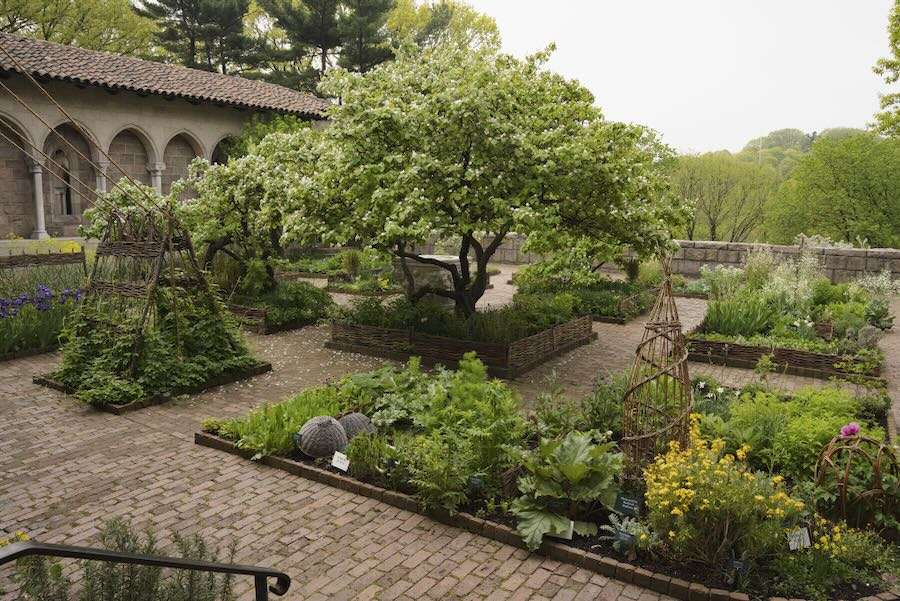
Carly oversees the three main gardens that hold the museum’s living collection. One of those three is the Bonnefont Cloister Herb Garden (above).
Read along as you listen to the Aug. 5, 2024 edition of my public-radio show and podcast using the player below. You can subscribe to all future editions on Apple Podcasts (iTunes) or Spotify (and browse my archive of podcasts here).
 medieval herbs for today, with carly still
Margaret Roach: Hi, Carly. You’re surviving this crazy weather season and all of it [laughter]?
Carly Still: Yeah, trying to stay steady, like all gardeners in general.
Margaret: Yes, yes. Well, we recently did a “New York Times” garden column that was fun together, and that’s why I wanted you to come and also share some of your knowledge and some of the wonderful herb stories with the listeners of my podcast. If people are near New York City, the Cloisters is a must destination, and I think both the gardens and what’s inside the museum are pretty special. I mean, it is like a whole other world. It must be a wonderful place to work.
Carly: It absolutely is. I feel very fortunate to be able to be managing the gardens here. I think that’s one of the common themes that I hear visitors say is they feel like they’re transported or they’re back in Europe. It really does have this magical ability to inspire, and to allow people to slow down. I think that that’s really a big part of my work in the gardens, is to reintroduce people to some of these herbs that I feel like do live within us.
Margaret: With their incredible histories. Herbs, again, not just parsley, sage, rosemary, and thyme. What’s an herb, do you think, and what have you come to regard as the definition of herb after… I think you’ve been there 13 years approximately, working at the Cloisters with its historical perspective. What’s an herb?
Carly: Oh, gosh. Well, like I said, I think that they’re really all-encompassing. I believe that an herb is really a plant that has a purpose and a use. At the Cloisters, I think what we’re really striving to get across is just how connected people are to plants and how plants were being used, herbs were being used, for all aspects of life. It’s much more than just making really nice salad or seasoning, which is also really-
Margaret: Tea, herbal tea [laughter].
Carly: Yeah. Wonderful and important. I love that people have that connection to their leafy greens, but the root of it all, I think is much deeper than that in the way that plants were really just such an essential part of life. To me, I think in herb really, or plants, all plants do have a purpose, and I think we have to broaden our perspective a little bit. Although we might not want to be welcoming all of these herbs into our own home gardens, I do think that there’s a responsibility to understanding how they have been used, and were really regarded, and we’re seen as allies for people. I hope that it’s a way to expand our thoughts about plants a bit.
Margaret: Within the herb garden then at the Cloisters, you have beds with plants grouped according to their purpose. So yes, there’s the vegetable and salads, I think your sort of edibles bed, and there’s different beds. I think you have a medicinal bed, but it’s almost like every herb was medicinal. When you read the histories of these herbs in some of the old books, it’s like everything had a medicinal use of one kind or another, it seems like.
Carly: Yeah.
Margaret: Yeah. It’s pretty amazing. But you have other kinds of beds, too, like household and magic and something—all these wonderful beds. Tell us just a little bit about some of them.
Carly: I think that that’s just a really was a brilliant way when this garden was designed for us to be able to really showcase these groupings of plants. You really nailed it, that most plants really did have a medicinal purpose. We always sort of have our disclaimer that’s like, “Well, if this plant is growing, say, in the magic and ceremony bed, It may also could be grown in the medicinal bed as well.” Or “this is the plant that’s in the household bed, but it was also used for this other purpose.”
But yeah, we’ve got our medicinal, we have our brewing herbs, so thinking about what people are drinking really throughout the day, their ales were much safer for people to be consuming than just water. Thinking about-
 Margaret: Yeah, and they used all kinds of different herbs before hops was the main thing of brewing; different herbs were used. What are some of the ones that were used that are in that group?
Carly: We had talked about costmary [above] in the Times, but the other common name for costmary is actually alecost. That sort of common name gives us a clue—ale cost—that was another flavoring agent. Then there’s mugwort, which is everybody’s-
Margaret: Nemesis, the nemesis. Now that you said costmary and you said it had another name that was-
Carly: Yeah, alecost.
Margaret: Alecost and ale, so to speak, cost. Then you’re saying mugwort. So, huh, mug. [Laughter.]
Carly: Yeah, mugwort. Then there’s one of my favorite plants that we also grow in the medicinal bed was clary sage. That was another flavoring agent, but wonderful, it has a fabulous fragrance to it. I think it’s just a beautiful flower. I remember that one as clary clear eye, because the seeds of that would’ve been soaked and it was like your medieval eyewash, but just really just one of my thinking about… I know I’m jumping from the brewing, but-
Margaret: No, but that’s the thing. Yeah.
Carly: They all continue to tell… You can work your way into thinking about fragrance when you start to think about clary, and the same for costmary, and both of these being very, very aromatic herbs. I do believe that there is a medicinal component to being able to smell something and really instantaneously having this really pleasant reaction to it or this uplifting reaction to it. You experience that.
Margaret: Yeah. Well, you told me when we did the time story, you told me that I think costmary, one of its common names was Bible leaf, and that leaves were dried in books, including the Bible.
Carly: Exactly. It’s this wonderful… Right, again, thinking about these kind of allies, it’s this wonderful herb that has this fantastic ability to uplift the person, and it would just be pressed within books. I think that common name, Bible leaf, just really sticks with you for your memory to think about how plants were being used.
Margaret: Right, if you were nodding off during your studies, you could get a whiff. I think it’s spearmint-y a little bit, a little bit aromatic?
Carly: Exactly.
Margaret: Yeah. Clary sage, I mean, Salvia sclarea, I just think… I used to have that in my sort of crack and crevice patio garden-y area many years ago. Now that you’re mentioning it, I’m wanting it again. It’s one of those self-sowers that moves around, but it’s just a lovely plant—architectural, but also has sort of, I think, a rosette down by the base.
Carly: Yeah.
Margaret: Just a wonderful sage, an unusual sage, compared to the culinary sage.
Carly: It’s just a little bit of a sweeter fragrance, too. It’s not as pungent. Just a really, really elegant flower, I think. A lot of these feel easygoing to me. I don’t know, you don’t have to be overly tending them. They want to set their seed, and clary is one of those that just reliably sets seed in the area where we want it to grow. It doesn’t take over the garden.
It’s also a plant that’s in the Unicorn Tapestries. That’s a flower that we’re also growing over in the Trie Cloister garden, which is inspired by those tapestries. I guess through that, you can also see how we’re interpreting plants in the permanent collection as well within this garden.
Margaret: Right, so the Unicorn Tapestries, I guess what, there are seven of them or something maybe from, I don’t know. Is it right around the beginning of the 1600s? Or is it the 16th century? I can’t remember.
Carly: Yeah, 16th century.
Margaret: The 16th century. In the permanent collection within the museum, that’s one of probably the most visited, the best-known parts of the collection, is the Unicorn Tapestries. You and previous gardeners there obviously have examined them and interpreted in the living collection outdoors, some of the plants that went into them or that are depicted in them. I think even the plants that were used to dye the threads that made the tapestries, you even grow those, right?
Carly: Yeah, we do. Yeah. They’re really a wonderful prize piece in the collection. I think from the gardener’s perspective, one of the ones that’s just fascinating to go in and be able to identify flowers that are depicted in there and just really admire the skill of the artists that spent all those years, I imagine, producing these collections.
Within the herb garden, we have our garden bed that’s devoted to artists’ materials, and so we have lots of dye plants. And the three main dyes, the madder [below], woad and weld that were used for these tapestries, are grown in that bed. Of course, those being red, yellow, and blue, although I don’t know which order I said the common names in.
 Margaret: Well, I think madder is red. Is madder red from the roots, is that right?
Carly: Yeah. Madder was red from the roots.
Margaret: Woad, which color do we get from woad [below]? Even though the flowers are all yellow, what color do we get from woad?
 Carly: Yes. It’s such a beautiful plant. The leaves of the woad will yield blue. The weld [above] is the yellow. The whole plant, excluding the root, can yield the yellow.
Yeah, just a really wonderful way for us, I think as a museum, as a collective museum, to be able to also just illustrate how interconnected our living collections, being the gardens, and our permanent collection—there really is this sort of dialogue that’s existing between the galleries and the gardens, which I think is really what sets our museum apart. It really does make it feel very unique and very much alive.
 Margaret: Again, I think that’s part of the reason for what you were saying at the beginning, how people come and they feel this sense of transformation, or they’ve come to a different world. Because both indoors and outdoors and the architecture of the building and the Cloisters, the archways and the walkways outdoors and so forth with, in some cases, actual historic pieces of architecture from elsewhere that have been transported and put back together and so forth. It really feels like, plus it’s planted like, and all the artifacts and art inside are this medieval era. It’s a world unto itself, really.
Carly: Yeah. I think one of the things that I find so beautiful, particularly within the herb garden, is just this common thread. These plants existed and they still exist to this day. I think when people go into the herb garden, I really do call this the garden of stories. There’s so much dialogue that comes up between the visitors and the workers, the gardeners, because these plants trigger memory.
I often hear people say, “Oh, quince,” which we grow this fruit tree in the herb garden, and it’s not very common here in the Northeast, but lots of people from South America and Europe say, “Oh, I remember my grandmother, or so-and-so had this in their garden.” Or a fig, ‘I remember this from whoever’s garden.” It’s just really a wonderful way for people to be able to also share their experience and parts of their life with us.
I think that that’s essentially what we’re doing. We’re telling the stories of these plants, but everybody also has their own experience, and it’s just wonderful to be able to share that with one another.
Margaret: When we did the Times story, you told me about again, all the different beds with their purposes and so forth, and the one that, of course, besides the magic and ceremony one, the one that cracked me up was the love bed [laughter]. You told me about a plant, Dittany of Crete [below]. Tell us about dittany and what it’s related to and so forth.
 Carly: Dittany is just one of the sweetest little herbs, and it’s an oregano. It’s a native endemic to Crete, so you can imagine this really rocky, dry sort of cliffy areas. The story that I’ve always hung to, because I’m a romantic at heart [laughter], is that these sweet woolly, it’s got… Well, let me go back to the description: It’s got these really beautiful, small, delicate, woolly little leaves, and then just these really beautiful, pinkish flowers. They’re just very delicate.
Anyways, they talk about how this was a love charm. It was this very symbolic herb. A lover might be out risking his life to collect the herb for the person that he or she has their eye on. It was just a really terrific-
Margaret: Right, to go on the rocky cliffs and risk life and limb to get some of these tiny flowers off this precipitous, unstable ground.
Carly: Forget diamonds. What we all need is some dittany [laughter].
Margaret: Right. Dittany. What is it? Is it like Origanum dictamnus, is that what it is? Did I make that up? Sometimes I make stuff up [laughter].
Carly: Nope, that sounds right to me.
Margaret: O.K. Again, we all know oregano, but there’s so much a range of related plants, and this is one of them and it has this charming story. I think you grow it in pots.
Carly: Yeah, we grow it in pots. You can use it similarly in cooking, but it’s just a really sweet little herb. I think also when you grow things in pots, people notice them a little bit more, and you’re also able to lovingly care for them a little bit more. But it doesn’t want to be in our wet winter soil.
 Margaret: No. When we did the Times column, you mentioned a few edibles that I had never grown, a few edible herbs. It’s not that they’re impossible or whatever, it’s just I had never… One is called skirret and one is salad burnet [above]. I just wondered if you could tell us about those, because they were both adorable and kind of interesting. The parts that were edible and the flavors that they imparted, were unexpected in each case. They don’t look like what they taste like, either one.
Carly: Yeah. Yeah. Well, truthfully, that cute little salad burnet, the Sanguisorba minor, was really… I know sanguisorbas from lots of ornamental forms of that, but this little one really has charmed me. It’s just really a small plant. I actually just planted some over in Trie Garden, because I wanted to see how it would look just as an ornamental plant on its own. It just has really ornate little leaves. The minute that you cut into it releases this really… It’s cucumber and I almost feel like there’s almost a hint of watermelon, just smells very fresh.
It’s wonderful to add into a salad or nice restaurants, I’m sure, just use it as a really beautiful little garnish on a plate. Just really elegant, and kind of a no-nonsense herb. That’s been one of my new favorites.
Then skirret gets quite tall, but it has these really lovely, umbel flowers [below] that I’m just discovering are really, really long-lasting. They serve as a great cut flower, which has been a really nice surprise this year because it can get a little bit… It falls over a bit. [Laughter.]
Margaret: Don’t we all in this heat? Don’t we all?
 Carly: Yeah, exactly. If you cut it and throw it into a vase, it really lasts long. The roots of that are what was the edible part. It was sort of cooked almost like a carrot or a parsnip, but it has these finger-like little unusual-looking roots. It’s something that’s a little bit more unusual.
Margaret: You mentioned Trie Garden before, and that’s one of the three cloisters at the Cloisters, one of the three gardens. We’ve been talking about the Bonnefont Herb Garden, and then there’s the Cuxa, is that how you say it, Cuxa Cloister? So there’s three primary gardens, including the Trie, just so people know what you mentioned before.
I was just going to say: A couple of beautiful little flowers that are just easy to grow, and yet I think not enough people grow them. I don’t think even people think of them as herbs, again because of that definition that we have of culinary green stuff. Calendula and borage, you really love and you say they’re your favorite medieval flowers. Tell us about those two, because those are so charming.
Carly: Borage and calendula, I find to just be so easy to grow from seed, so I love that, this ease to it. This calendula, this Calendula officinalis [below], they were known as “golds” because of this beautiful sort of orangey golden color that the flowers have. They talk about this color and this flower being really good for balance. If we’re feeling a little bit out of sorts by gazing into this flower form, we kind of can get some ease, which I think we’re all looking for.
I love this deep admiration for flowers. That’s one of those. It of course was used for all sorts of other purposes, for natural dyes. I mean, we use calendula in all sorts of ointments and healing creams today.
Margaret: I think you can eat the flowers, can’t you?
 Carly: Yeah. That’s right. One of its other common names was pot marigold. This was a plant that was also edible and being thrown into the pot, thinking about diet. Similarly, borage is another edible flower and just-
Margaret: Blue. Beautiful blue, huh?
Carly: Beautiful blue [below]. We talked about that quote, “A garden without borage is like a heart without courage.” So just this really refreshing, encouraging characteristic that this flower encompasses, just rooting us on while we’re out in the garden bed. That brings me some cheer. There’s so many great herbs, Margaret. I just want to keep telling you about more.
Margaret: You have a link on your website, on the Cloisters website, to the plant lists of the gardens as well, I believe.
Carly: Yes, that’s right.
 Margaret: I’m going to make sure to give that and information about visiting. I think you have tours and things. Do you have tours at certain times?
Carly: Yeah, that’s right.
Margaret: I can give all the links to how people who are in the area or coming to the area this summer or fall or whatever can come and visit, because it’s really an unusual escape, a very distinctive place. I always love talking to you, Carly Still. Thank you so much for making time today. I know you have eight million things to do on your list [laughter].
Carly: Oh, no. I’m happy to slow down a bit.
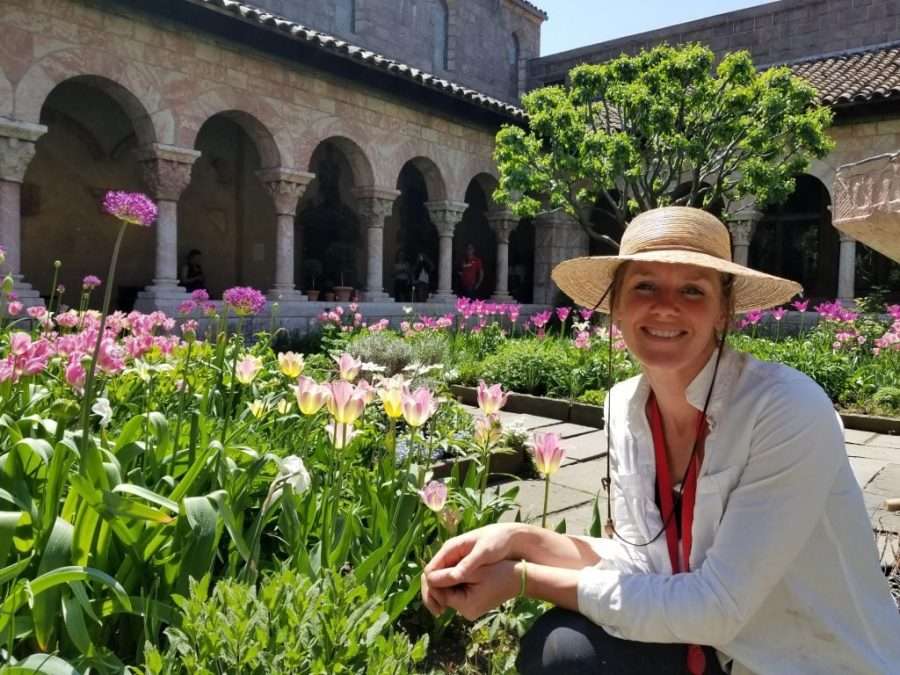
(Photos by Carly Amarant, except portrait of Carly Still courtesy Metropolitan Museum of Art.)
prefer the podcast version of the show?
 MY WEEKLY public-radio show, rated a “top-5 garden podcast” by “The Guardian” newspaper in the UK, began its 15th year in March 2024. It’s produced at Robin Hood Radio, the smallest NPR station in the nation. Listen locally in the Hudson Valley (NY)-Berkshires (MA)-Litchfield Hills (CT) Mondays at 8:30 AM Eastern, rerun at 8:30 Saturdays. Or play the Aug. 5, 2024 show using the player near the top of this transcript. You can subscribe to all future editions on iTunes/Apple Podcasts or Spotify (and browse my archive of podcasts here).


Margaret…..
I so luv your posts-especially this one.
Hydrangeas. Medicinal herbs & Clafouti.
It particularly speaks to me!
Clafouti for breakfast this AM, I think….
Karla
Looking for the name of the big, busy yellow plant under the section where you talk about the “woad”. I loved this article. I would love to visit.
Thanks,
Karen
Always inspiring, I loved this episode today with the Cloisters gardens and lovely mentions of specific herb/flowers , medieval apothecary, the medieval fantasy garden with the Unicorn Tapestries’ myriad of flowers and fruits. I am left once more with the desire to visit New York just to see the Gardens of the Met. I think I could be at the Met quite happily on a daily basis. Of course, the itch always comes to garden in my yard. Thank you,, Margaret and Carly!
Oh, how I would love to visit there, stroll around the Gardens in quiet contemplation…I have grown many herbs, Borage included. The beautiful blue flowers look lovely in a salad, or sugared in a desert!
What a delightful podcast! More herbs are now on my to-plant list, and to use.
Thank you!
Great show! Never knew all that was at the Cloisters!!
So interesting! I grow many typical culinary herbs, and now grow borage. One of my favorites, and it re-seeds!